For two days every September, Costa Rica closes its main streets. Lantern parades on the night of the 14th, marching bands on the morning of the 15th, and a country that stops to sing. Here is what actually happens, which roads shut down, and how to keep your travel plans intact — from a team that drives these roads every week.
On September 15, 1821, Central America declared its independence from Spain. In 2026 that makes 205 years — and in Costa Rica the anniversary is not a quiet civic date on a calendar. It is the loudest, most colorful week of the year, and for two days it changes how the entire country moves.
If you are traveling in Costa Rica in mid-September, nobody is likely to warn you about this in advance. Then on the morning of the 15th you find the main street of your town closed, a marching band coming through it, and your driver taking a route you did not expect. This guide explains exactly what happens, when, and what it means for getting from one place to another.
September 14 and 15 are the two days of the year when almost every town center in Costa Rica closes to traffic. Plan around them and they become the best thing you will see on your trip.
September 14: the torch and the anthem
The celebration starts the night before. Late in the afternoon of the 14th, the Freedom Torch — a relay that begins in Guatemala and is carried on foot by student runners across every Central American country — crosses into Costa Rica and makes its way toward Cartago, the old colonial capital. It is met at each town along the way by people lining the road.
Every year the Antorcha de la Libertad is lit in Guatemala and carried on foot, hand to hand, across Guatemala, El Salvador, Honduras, Nicaragua and Costa Rica. It is not a ceremonial jog: it is thousands of students, athletes and neighbours running relay legs along the main roads, day and night, for days, until it reaches Cartago — Costa Rica's old colonial capital — late on the afternoon of September 14.

The torch represents the news of independence travelling south in 1821, when word had to be carried by messenger and took weeks to arrive. If you are driving on the 13th or 14th, you may well pass a leg of it: a cluster of teenagers in school colours running along the shoulder with a police escort and a support truck. Slow down and give them the lane. It is the single most photographed thing of the week and you will not have to look for it.
At six o'clock in the evening, the country stops and sings the national anthem at the same time. In schools, in town squares, in living rooms, in restaurants. If you happen to be in a small town at that hour, step outside. It is a genuinely moving thing to witness, and it lasts about three minutes.
El Desfile de Faroles: the lantern parade
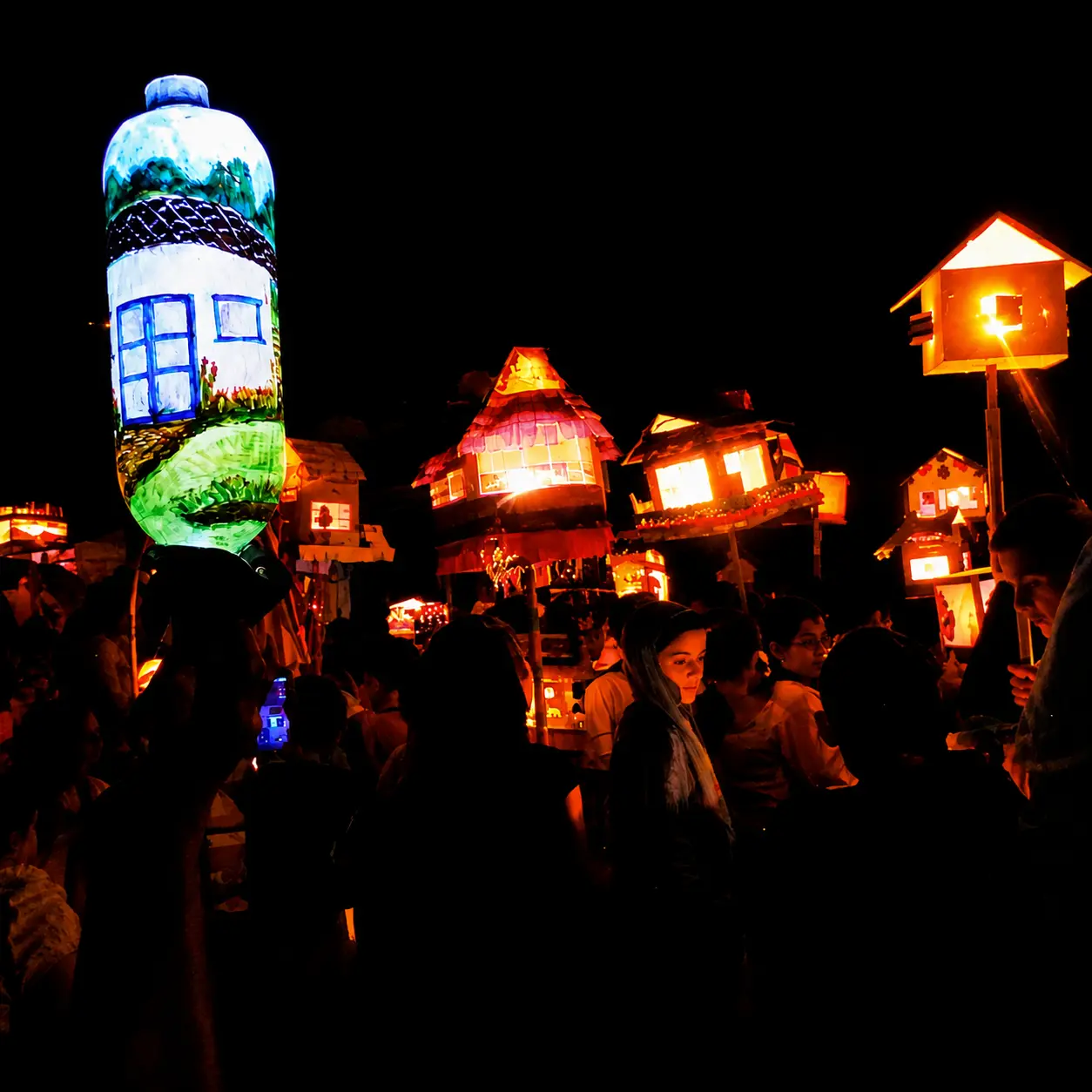
Then comes the part everyone remembers from childhood: el Desfile de Faroles, the lantern parade. Children walk through their neighborhood after dark carrying handmade lanterns — traditionally built at home out of cardboard, tissue paper and a candle, though most now use a small light inside. Every school makes them. Every family has a story about one that caught fire. The parades are small, local and unhurried, and they happen in essentially every town in the country between roughly 6 and 8 in the evening.
For a visitor this is the single most worthwhile thing to see, and it costs nothing. Ask at your hotel where the closest one passes.
September 15: the parades
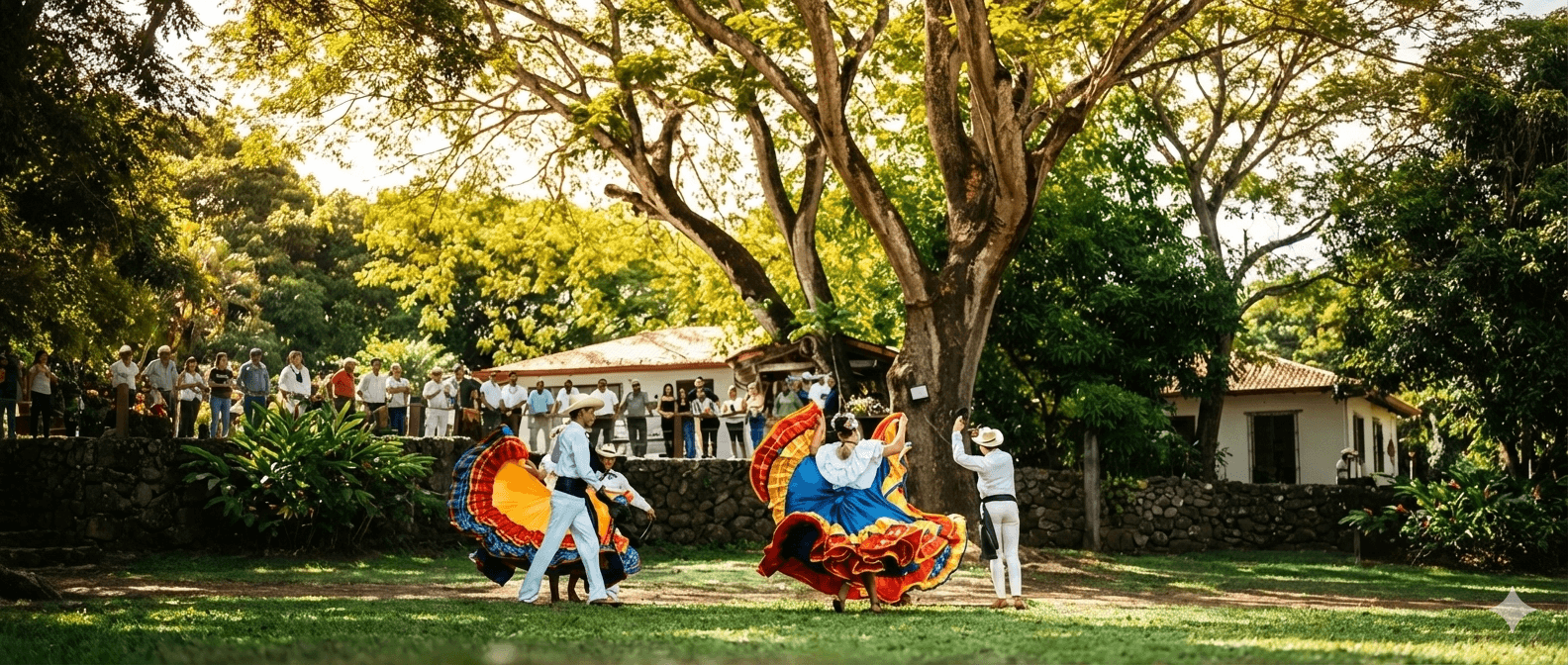
The 15th is a national holiday, and the morning belongs to the desfiles. Schools march through the main street of their town with drum lines, flag bearers and baton twirlers, in full uniform, for hours. In San José and the larger cities this is a big production; in small towns it is the whole community standing on the sidewalk watching their own kids go by.
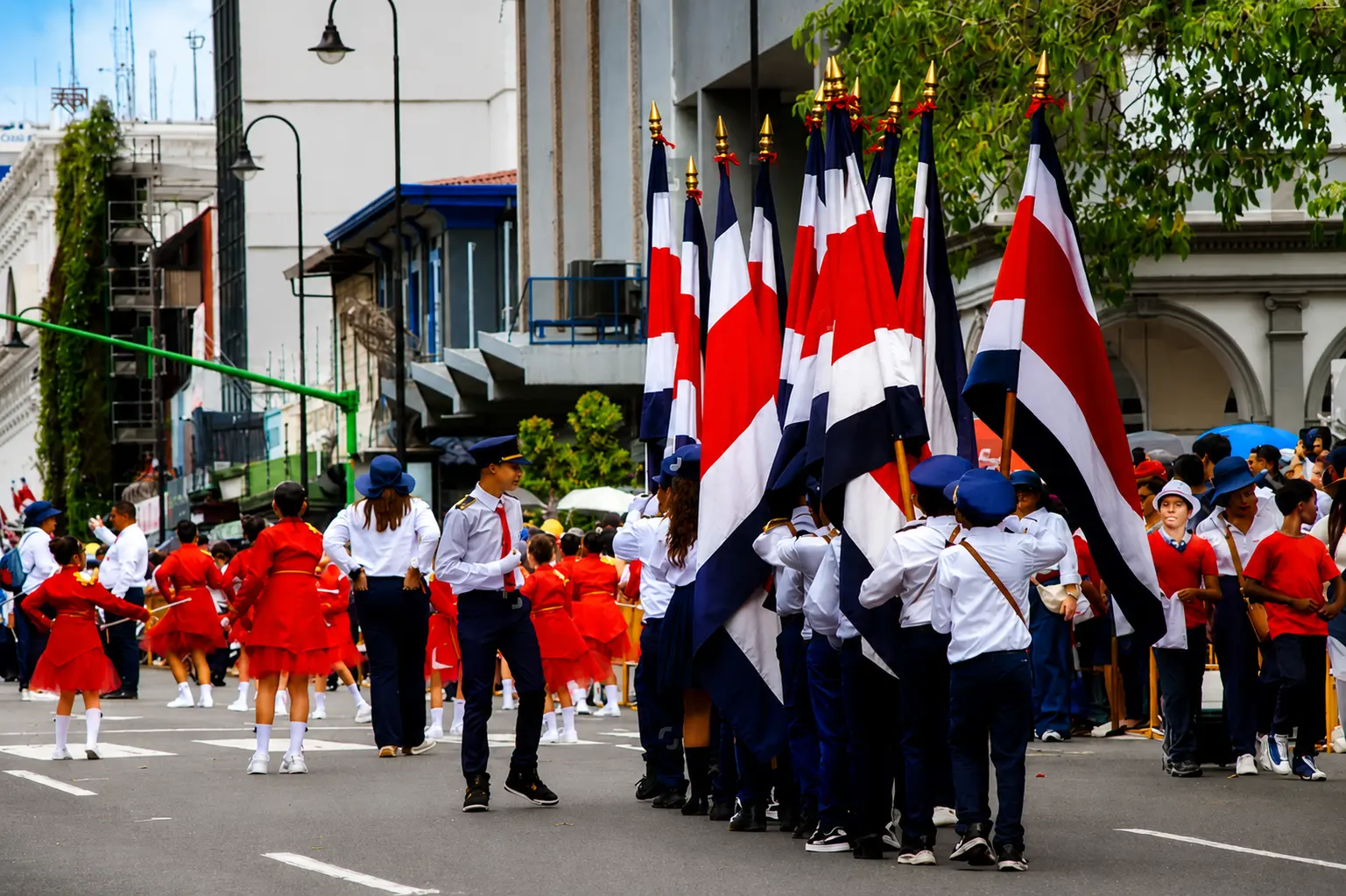
Practically speaking: the main street of the town is closed while this is happening, usually from early morning until somewhere around midday, depending on how many schools are marching. Side streets around the route get blocked too, and the traffic that would normally use the center gets pushed onto whatever is left.
Mascaradas and cimarrona
Woven through all of it are the mascaradas — giant papier-mâché figures worn over the head and shoulders, danced through the street by whoever is brave enough to carry one. They chase children, they mock the crowd, they are supposed to be a little frightening. Behind them plays the cimarrona, a rowdy neighborhood brass band that has no interest in being in tune and every interest in being loud.
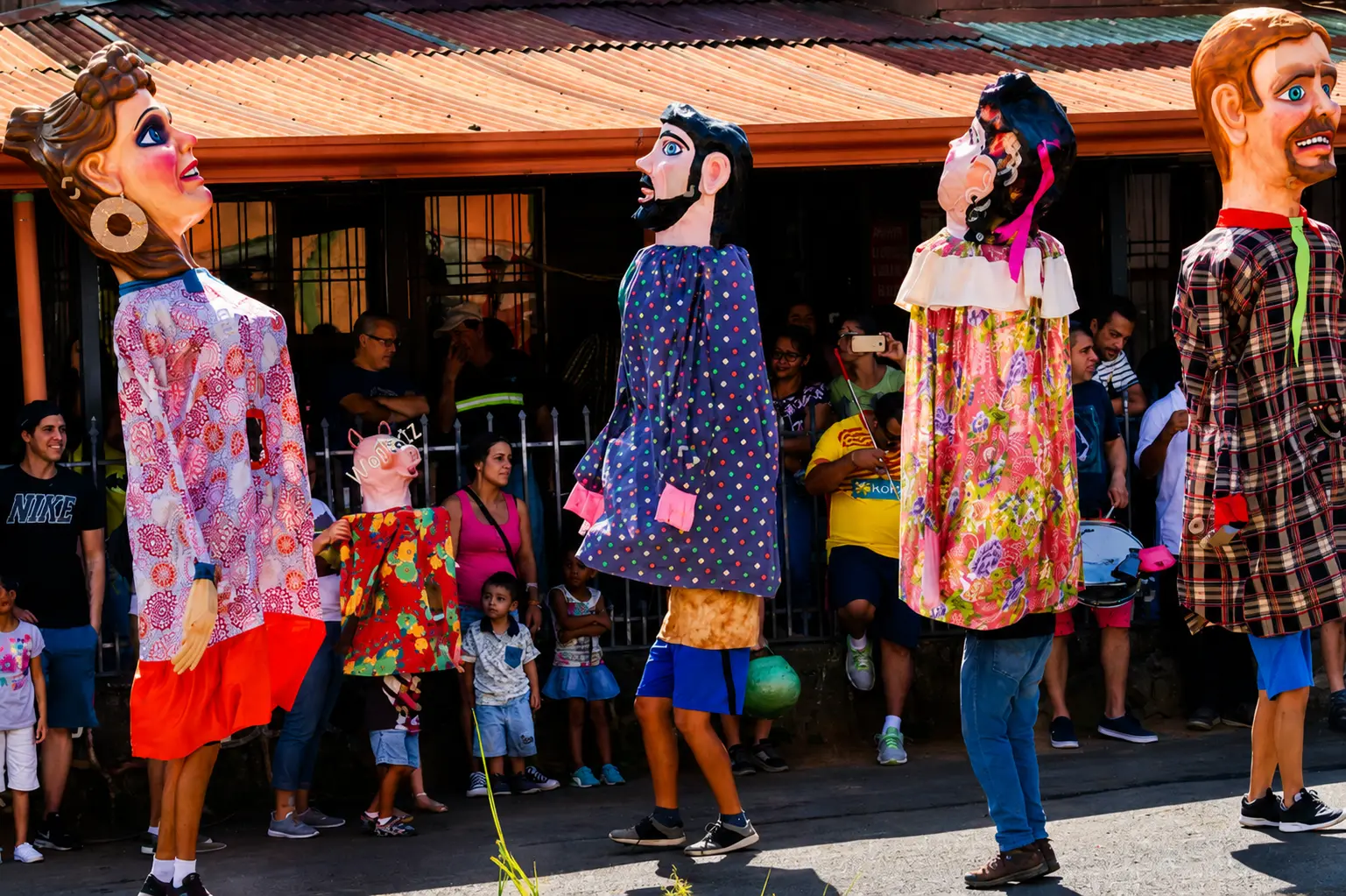
This is the oldest layer of the celebration, and it is not staged for tourists. If you see one, stand back a little and let it come to you.
What this actually means for your transfer
Here is the part no cultural guide will tell you, and it is the reason we wrote this. If you have a transfer booked on September 14 or 15, the trip is not the same trip it would be on any other day.
- Town centers close. Not highways — the routes between destinations stay open. What closes is the main street of each town, which is often exactly where your hotel is and where a driver would normally pick you up.
- Pickups move. If your hotel sits on or just off a parade route, the driver cannot reach the door during the parade. The fix is simple — a meeting point two or three blocks out — but it has to be agreed the day before, not at 7 in the morning.
- The evening of the 14th is affected too. Lantern parades run roughly 6 to 8 pm through residential streets. An airport run leaving at that hour needs extra time just to get out of town.
- The 15th is a public holiday. Banks and public offices are closed, and many restaurants and shops keep holiday hours or shut entirely. Public buses run reduced holiday schedules, and the ones that do run are full.
- Everything takes longer. Even outside the closures, traffic is heavier and slower than a normal Tuesday because the whole country is out.
None of this is a reason to avoid traveling on those days. It is a reason to not improvise them. A driver who has worked these two days for years already knows which street the parade in Grecia uses, where you can actually stop in La Fortuna on the morning of the 15th, and how much earlier you need to leave Manuel Antonio to make an afternoon flight.
On September 15 the answer is never a shorter route. It is leaving earlier and knowing which corner the band turns.
Traveling on September 14 or 15? Tell us your hotel and your times and we will build the day around the closures — pickup point included.
Plan my transferThe rodadas: an unofficial tradition that turns dangerous
There is a second road issue that has nothing to do with parades, that no tourism board will mention, and that most visitors have never heard of. Since around 2022, Costa Rica has seen the rise of enormous motorcycle caravans — rodadas — organized through social media and gathering between 500 and 1,000 riders at a time. Nobody sanctions them. Nobody permits them. They have simply become an unofficial tradition, and around the patriotic holidays they get bigger.
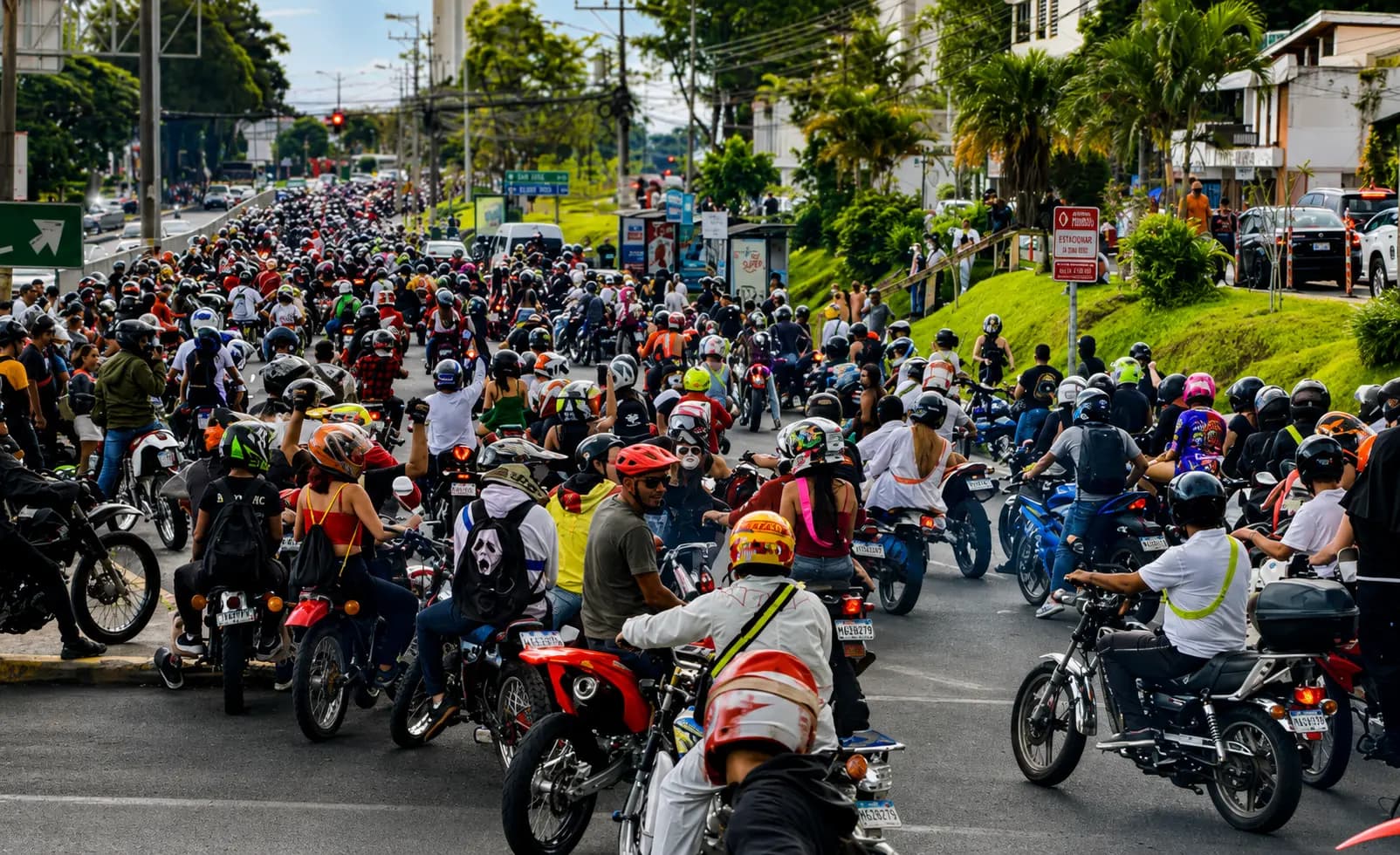
The routes they favour are, unfortunately, exactly the ones your transfer uses: Ruta 27 to the Pacific coast, the Circunvalación around San José, the General Cañas to the airport and the Florencio del Castillo to Cartago. Traffic police receive around five reports a week and acknowledge the difficulty of controlling it — the groups scatter before officers arrive. Roughly 7,000 motorcycles were seized over the past year.
- What gets reported: lanes blocked outright, ambulances unable to get through, street racing, and riders travelling on one wheel through moving traffic.
- What the national numbers look like: in the first half of 2026 the state insurer recorded 18,036 injured motorcyclists — around 67% of all road emergencies in the country. In the first four months of the year, 56% of road deaths were people on motorcycles.
- What it means on the road: if a caravan forms ahead of you, traffic goes from flowing to stopped in about a minute, and it clears on its schedule, not yours.
- What an experienced driver does: holds back and lets it move away. Never overtakes into one, never tries to thread through it, never engages.
To be precise about what is and is not documented: the authorities track the caravans as a year-round weekend and holiday-period phenomenon and do not publish a breakdown by date. What we can tell you is what operators who work these roads see — the holiday weekends are the heavy ones, and September is a holiday weekend.
Thinking of renting a car for those days? Read this first
Renting a car in Costa Rica is a perfectly good idea most of the year. September 14 and 15 are the two days we would tell a friend not to. It is not about the roads being bad — it is about a specific stack of conditions landing on the same 48 hours, on a driver who has never driven here before.
- The detour is the hard part, not the closure. When a town center shuts for a parade, there is no signed alternate route. You are expected to already know which side street connects back to the highway. A visitor with a phone map does not, and the map will keep routing you into the closed street.
- Parking near a parade is not a thing. Every space within walking distance of the route is taken by families who arrived at six in the morning.
- The lantern parades run through residential streets after dark. Narrow roads, no lighting, hundreds of children walking on the asphalt. This is the single highest-risk driving situation of the year for someone unfamiliar with the town.
- The caravans are on the main routes. If you meet one on Ruta 27 in a rental car, you are the least experienced driver in that situation by a wide margin.
- Everything is fuller and slower. Costa Ricans are travelling to see family, the highways are heavy, and the margin you built into your schedule disappears.
None of this makes the days dangerous to travel. It makes them days to be driven by someone who already knows the answer. Our drivers grew up in these towns. They know which street the Grecia parade uses, where you can actually stop in La Fortuna on the morning of the 15th, and to sit back and wait when a caravan appears rather than trying to get past it.
Any other week of the year, rent the car. On the 14th and 15th, let somebody who knows the detours drive — and spend the day watching the parade instead of the map.
Skip the rental for the holiday. Private transfer, door to door, with a driver who knows every closure on the route.
See routes and pricesThe routes that feel it most
Some trips barely notice the holiday. Others run straight through four or five town centers, and those are the ones to give extra time.
- SJO Airport to La Fortuna — passes through the Central Valley towns and then Zarcero or Ciudad Quesada, all of which hold parades. Add an hour on the 15th.
- SJO Airport to Monteverde — the climb goes through several small communities where the road through town is the only road.
- La Fortuna to Manuel Antonio or Jaco — long, and it threads a number of town centers on the way south.
- Anything into or out of San José downtown — the capital's parade is the largest in the country and closes a significant part of the center.
- LIR Airport to the Guanacaste beaches — the least affected of the big routes. The highway stays open and most beach towns hold smaller, shorter parades.
If you are here for it, do this
- Be somewhere small on the night of the 14th. A village lantern parade beats a city one by a wide margin.
- Be outside at 6 pm on the 14th for the anthem, wherever you are.
- Ask your hotel what time the local parade starts on the 15th — the answer changes town by town.
- Buy food the day before if you are self-catering. Supermarkets keep holiday hours.
- Do not schedule a tight airport connection for the morning of the 15th. Move the flight or leave very early.
Frequently asked questions
Is September 15 a public holiday in Costa Rica?
Yes. Independence Day is a national holiday. Banks, public offices and many businesses are closed, and public transport runs on a reduced holiday schedule. Hotels, private transfers and most tourist attractions operate normally.
Will road closures affect my private transfer?
Only in the towns themselves, and only while the parades are running — the highways between destinations stay open. What changes is the pickup: if your hotel is on a parade route, the driver meets you a few blocks away instead of at the door. Agree that with your operator the day before, not the same morning.
How much extra time should I allow on September 15?
Plan on an extra hour for any trip that passes through several town centers, and more if you are leaving from or arriving into San José. For a flight, we would leave two hours earlier than we normally would.
Are public buses running on September 14 and 15?
Buses run on a reduced holiday schedule on the 15th, and the services that do run fill up quickly because the whole country is traveling to see family. If you are moving between destinations on those two days, a private transfer is the difference between arriving when you planned and losing the day.
Should I rent a car in Costa Rica for September 14 and 15?
We would not, and we say that as people who think renting a car here is a great idea the rest of the year. The problem is not the roads — it is that town centers close with no signed detour, your map keeps routing you into the closed street, lantern parades fill residential streets with children after dark, and the unofficial motorcycle caravans known as rodadas swell on holiday weekends along Ruta 27 and the other main routes. A local driver already knows every one of those answers. Rent the car for the rest of the trip.
What are the 'rodadas' and are they dangerous?
Rodadas are large, unsanctioned motorcycle caravans organized on social media that can gather 500 to 1,000 riders and take over main routes such as Ruta 27, the Circunvalación and the General Cañas. They are not part of the independence celebrations and are not authorized by anyone — they have simply become an unofficial tradition that operators see swell around the patriotic holidays. Traffic police report roughly five incidents a week and around 7,000 motorcycles seized in the past year, with lane blocking, obstructed ambulances and street racing among the reported behaviour. If one forms ahead of you, hold back and let it pass; never try to overtake through it.
Where is the best place to see the celebrations?
For the lantern parade on the night of the 14th, a small town beats a city — the atmosphere is completely different. For the marching parades on the 15th, San José, Cartago, Heredia and Alajuela put on the biggest ones, while towns like Grecia, Sarchí and Atenas offer something more traditional and much easier to watch without crowds.
Should I avoid traveling in Costa Rica in mid-September?
Not at all. Mid-September is green season, which means fewer visitors, lower prices and mornings that are usually clear even when afternoons are wet. Add the independence celebrations and it is one of the most rewarding weeks of the year to be here. It simply needs to be planned rather than improvised.
Costa Rica does not celebrate its independence with a military parade. It celebrates with children carrying paper lanterns through the dark, with a torch handed from one pair of hands to the next across four borders, and with an entire country singing at the same minute. If your trip happens to land on those two days, you have been handed something most visitors never see.
Let us handle the roads so you can watch the parade. Private transfers across Costa Rica, driven by people who grew up in these towns.
Book your transfer