From sea turtles in Tortuguero to jaguars in Corcovado — a region-by-region look at the animals that make Costa Rica one of the most biodiverse places on the planet.
Costa Rica makes up barely 0.03% of the Earth's surface, but it holds close to 6% of the planet's known biodiversity. More bird species than the US and Canada combined. More types of butterflies than the entire African continent. More biodiversity per square kilometer than anywhere else on Earth. But what you actually see depends on where you go — each region has its own ecosystems, its own microclimates, and its own cast of wildlife. Here's what to expect in four of the country's wildest destinations.
Tortuguero: Where the Caribbean Meets the Rainforest
There are no roads into Tortuguero — you get there by boat through a maze of jungle canals or by small plane. That isolation is exactly what makes it special. The park sits on the northern Caribbean coast, where rivers meet lagoons and the whole landscape is a vast, wild wetland. Some people call it the Amazon of Costa Rica, and honestly, it earns the comparison.
Tortuguero is famous for its sea turtles. Between July and October, green sea turtles crawl up the black sand beaches at night to lay their eggs — over 100 per nest. It's one of the most important nesting sites in the Western Hemisphere. Guided night walks let you watch it happen in complete silence and darkness. Earlier in the season, from March to June, leatherback turtles nest here too — the largest reptiles alive, reaching up to 500 kilos.
The canal boat tours at dawn are where you see everything else. Caimans lying still on the banks. River otters hunting in pairs. Basilisk lizards — the famous 'Jesus Christ lizards' — running across the water. Sloths hanging from cecropia trees. Howler monkeys roaring so loud you feel it in your chest. The bird list here tops 300 species, including endangered great green macaws and keel-billed toucans. On the forest floor, look for strawberry poison dart frogs — tiny, bright red, and carrying their tadpoles on their backs to water pools in bromeliad leaves.
- Green sea turtles and leatherback turtles (seasonal nesting)
- Sloths, howler monkeys, and white-faced capuchins
- Caimans and crocodiles along the canals
- 300+ bird species: great green macaws, toucans, tiger herons
- River otters, basilisk lizards, and poison dart frogs
- West Indian manatees — rare, but they're here
La Fortuna & Arenal: The Volcano and the Frogs
La Fortuna sits at the foot of Arenal Volcano, and the combination of volcanic soil, heavy rainfall, and overlapping weather systems from both coasts makes this area incredibly rich in wildlife. The Arenal Hanging Bridges take you through the canopy on suspension bridges up to 50 meters high — right in the zone where most of the action happens. Coatis cross the trails without a care. Toucans hop between branches at eye level. A good guide will spot things you'd walk right past: a camouflaged eyelash viper on a heliconia leaf, or a sloth so still it looks like part of the tree.
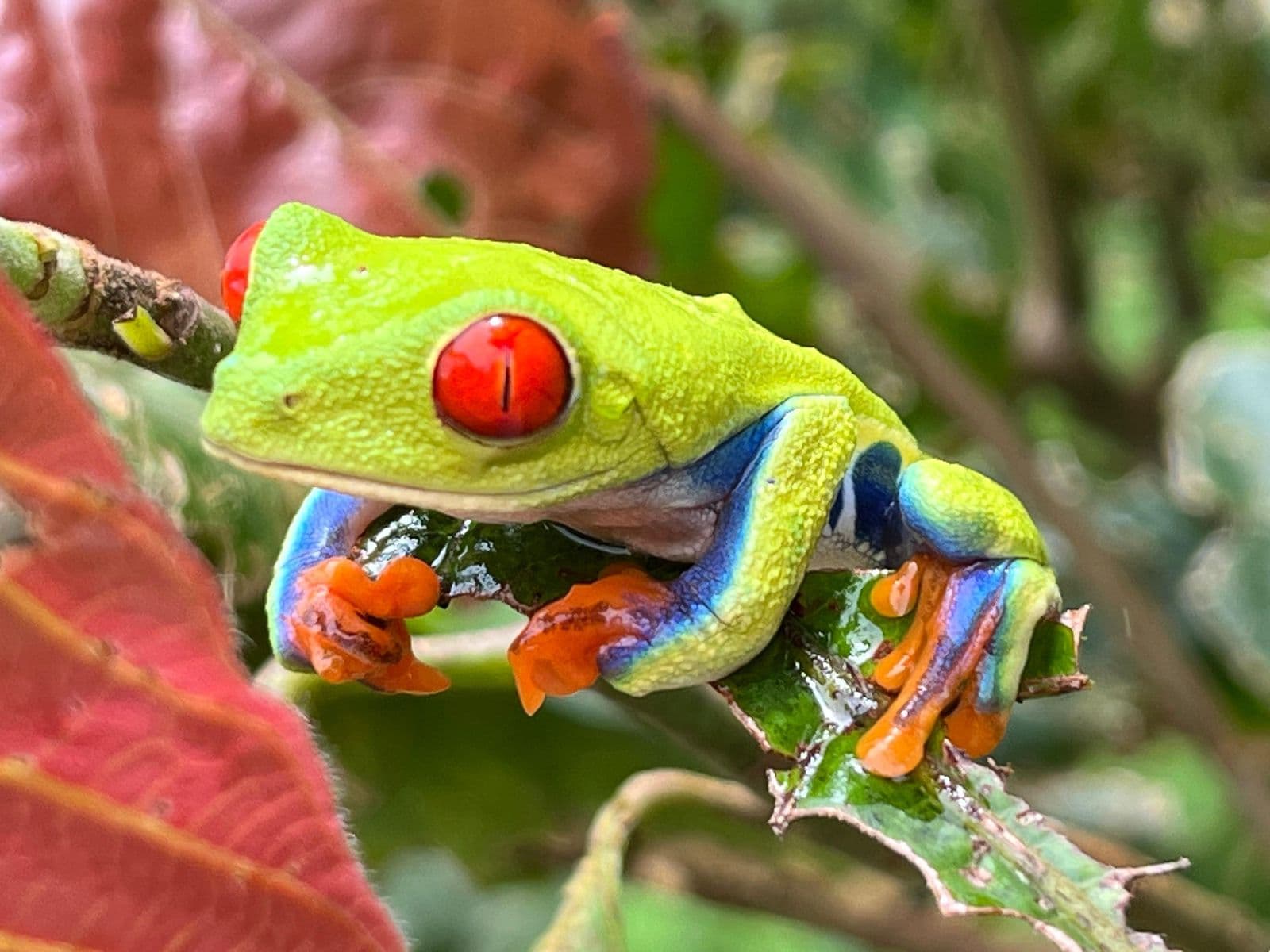
But the real showstopper in La Fortuna is the night tour. About 70% of tropical mammals are nocturnal, and the frogs that come out after dark are unreal. Red-eyed tree frogs sitting on leaves like little jewels. Glass frogs with transparent bellies — you can see their hearts beating. Poison dart frogs in electric blues and reds. And even at the hot springs, you're not alone — howler monkeys in the trees overhead, coatis wandering around, blue morpho butterflies drifting past. In La Fortuna, nature is the backdrop to everything.
- Two-toed and three-toed sloths in the canopy
- Coatis, agoutis, kinkajous, and tayras
- Keel-billed toucans and 500+ bird species in the Arenal area
- Red-eyed tree frogs, glass frogs, and poison dart frogs (night tours)
- Howler monkeys, spider monkeys, and capuchins
- Eyelash vipers, fer-de-lance, and blue morpho butterflies
Monteverde: The Cloud Forest
Monteverde is a different world entirely. At 1,400 to 1,700 meters of elevation, the forest is cool, misty, and permanently wrapped in clouds. Every surface is covered in moss, orchids, bromeliads, and ferns. The trees look ancient, their trunks hidden under layers of plant life. Walking through Monteverde feels like stepping into a forest that hasn't changed in a million years.
The resplendent quetzal is the star here — the bird the Maya considered sacred, with iridescent green plumage, a crimson breast, and tail feathers over 65 centimeters long. Monteverde is one of the best places in the world to see one, especially during nesting season from January to May when they feed on wild avocados. The three-wattled bellbird is another cloud forest highlight — its metallic 'bonk' can be heard half a kilometer away, making it one of the loudest birds on the planet.
Night tours in Monteverde reveal a hidden world. Olinguos — golden-furred, big-eyed mammals from the raccoon family — come out to forage. Tarantulas wait at their burrow entrances. Sleeping hummingbirds perch motionless on branches in a state of torpor. The forest holds over 2,500 plant species, 500 orchids, 400 birds, and 100 mammals, including the elusive Baird's tapir. It also carries a reminder: the Monteverde golden toad, last seen in 1989, is now extinct — likely the first amphibian lost to climate change.
- Resplendent quetzals — one of the best spots in the world to see them
- Three-wattled bellbirds with their unmistakable call
- 400+ bird species including hummingbirds, motmots, and trogons
- Olinguos, kinkajous, and Baird's tapirs
- 500+ orchid species and 2,500 total plant species
- Howler monkeys and capuchins in the canopy
In the cloud forest, every sense is engaged. The mist on your skin, the distant call of a bellbird, the scent of damp earth. Monteverde doesn't just show you nature — it immerses you in it.
Corcovado: The Most Biologically Intense Place on Earth
National Geographic called Corcovado the most biologically intense place on Earth, and it's hard to argue. On the remote Osa Peninsula, this national park protects 424 square kilometers of primary rainforest — the largest remaining tract on the Pacific coast of Central America. This isn't secondary growth or managed forest. This is the real thing.
Corcovado is where the big stuff lives. Jaguars — the largest cat in the Americas — have one of their healthiest populations here. You probably won't see one, but finding fresh paw prints on a beach at dawn is enough to change how the whole jungle feels around you. Pumas, ocelots, jaguarundis, and margays are also present — five species of wild cats in a single park.
What you will see are tapirs. Baird's tapirs — 300-kilogram animals, the largest land mammals in Central America — walk the beaches at dawn and dusk like it's nothing. Scarlet macaws are everywhere, flying in pairs, screaming overhead. All four Costa Rican monkey species live here, including the endangered squirrel monkey found only in this region. And the snakes demand respect: bushmasters (the longest venomous snake in the Americas), fer-de-lance, coral snakes, and eyelash vipers. A certified guide is absolutely required.
- Jaguars, pumas, ocelots, jaguarundis, and margays — five wild cat species
- Baird's tapirs walking on the beaches
- Scarlet macaws — largest wild population in Costa Rica
- All four monkey species: howler, spider, capuchin, and squirrel monkey
- Humpback whales offshore (seasonal)
- Bushmasters, fer-de-lance, and 40+ snake species
- 375+ bird species, 140 mammals, and 10,000+ insect species
Which One Is Right for You?
La Fortuna is the most accessible — great for families and first-time visitors who want wildlife with comfort. Monteverde is for the mystical, cool-climate cloud forest experience. Tortuguero is Caribbean isolation with one of the world's great turtle nesting spectacles. And Corcovado is raw, untouched wilderness for those who want the real deal. The best part? You can easily combine two or three of these in a single trip.
Tips for Wildlife Watching
- Hire a local guide — you'll see ten times more than on your own
- Go early. Peak activity is between 5:30 and 8:00 AM
- Don't skip the night tours — most tropical mammals are nocturnal
- Bring binoculars. Even cheap ones make a huge difference
- Stay quiet and move slowly. Less noise means more sightings
- Wear neutral, earth-toned clothing
Ready to explore Costa Rica's wildlife?
Book Your Private TransferCosta Rica is not a zoo. There are no cages, no feeding schedules, no guarantees. Every encounter is wild and every moment in these forests is earned. That's what makes it unforgettable.